
Tuesday 27.10.26 11am and 1pm Halton lea Library Runcorn WA7 2PF
FREE No Booking Required
THE WONDERSHELF- TMESIS THEATRE
Step into a magical bookcase where myths and legends burst into life! Join us on an unforgettable adventure packed with puppetry, music, and laughter. A celebration of imagination and the joy of reading. Perfect for curious minds and dreamers of all ages.
A commission for WordFest-Wakefield Libraries, this show is made by Liverpool’s renowned physical theatre company, Tmesis.
‘With The Wondershelf, Tmesis take you on a wondrous journey, which celebrates and inspires the imagination and the magic some of us forget we are capable of’ R Higson-Blythe- Wakefield Council
Suitable For Under 11s
Event type: Festival
Meet the Scientists
Scientists from the University of Liverpool will be taking over World Museum Liverpool on Saturday 21 November for a free, hands-on family science festival designed to inspire curiosity and discovery.
Visitors can explore interactive activities, follow a treasure map around the museum, and learn about everything from the human body to the natural world through hands on activities and experiments led by real researchers.
Meet the Scientists at World Museum will run from 10am to 4pm and offers families the chance to meet the people behind cutting-edge research taking place at the University of Liverpool. With activities suitable for children of all ages and opportunities to win prizes, theevent aims to make science accessible, exciting and fun for everyone.
Meet the Scientists is a partnership between the University of Liverpool and National Museums Liverpool, now in its 11th year. Held twice a year, the events bring researchers and local communities together to increase science capital, make research more accessible,build trust in science, and inspire curiosity. Read more about Meet the Scientists here.
Event detailsMeet the Scientists at World MuseumDate: Saturday 21 November 2026Time: 10:00am-4:00pmVenue: World Museum, William Brown Street, Liverpool
African Routes 2026: Fair Play
Three days of dance, talks and performance celebrating the African diaspora, exploring Fairness, Freedom and Friendship.
African Routes: Fair Play 2026
African Routes returns to The Black-E for three days of African and Caribbean dance, music and conversation. Artists, academics, educators, leaders and audiences come together for panels, masterclasses, workshops and performances on one question: how do we honour ourselves and our communities, and how does what we do make our lives better?
“Over three days, contributors, artists, academics, teachers, leaders, producers and audience will consider how what they do makes our lives better.”Karen Gallagher MBE, Curator
Day One, Friday 6 November: Fairness
- Opening libation from Dr H Patten MBE, and a welcome from Andrea Vaz, CEO of The Black-E, and Karen Gallagher MBE
- Panel One, Education and Access, with Dr Sharon Watson MBE DL, Beverley Glean MBE and Dr H Patten MBE, on who gets let in, and who gets to stay, in UK dance
- The nhaka masterclass with nora chipaumire and tyroneisaacstuart, a thinking lab built around the Black body and why we make art at all
- Liverpool, Reparations and Reparatory Justice, an arts and academia response, as part of the ESRC Festival of Social Science
- An evening showcase from the next generation of dance students
Day Two, Saturday 7 November: Freedom
- An Artists’ Coffee Morning with Janiece Myers
- A masterclass in free-spirited, socially engaged movement with Akeim Toussaint Buck
- The Black Dance Lecture, delivered by nora chipaumire, this year’s Tate Modern Infinities Commission artist
- Panel Two, Leadership and Curation, with Akeim Toussaint Buck, David Blake, Yusra Warsama and Nathan Powell
- An evening Triple Bill from IRIE! dance theatre, the IRIE! Artists Performance Project and Francis Angol
Day Three, Sunday 8 November: Friendship
- A welcome from Karen Gallagher MBE and Maxine Brown
- Panel Three, with Maxine Brown, Kerri Ankrah-Lucas and Wendy Okoli, on what dance does for a community beyond the stage
- In Conversation: Men in Dance, with Francis Angol and Dr H Patten MBE
- Afternoon workshops, including one with Ruvimbo Bliss Munodawafa exploring the body as a vessel for memory and story
- Maxine Brown presents Bend Down Low, a community showcase built on joy, to close the weekend
Tickets
All sessions are free, with an option to donate. Book a half day ticket for each morning, afternoon or evening session you would like to attend. Each ticket lists that session’s full timings and spaces.
The Halloween Fire Experience – Photoshoot
Join us for an unforgettable Halloween! An evening of Playing with Fire and a professional photoshoot in a ghostly haunted location
Ready to set your Halloween on FIRE? ?
Join our immersive Halloween experience of fire and fright.
Learn to play with fire under the guidance of two professional fire instructors. And capture the moment with a professional photoshoot by the incredible Tommy Wong, one of the best fire photographers in the UK.
YOUR NIGHT INCLUDES
? Fire experience — learn to move and play with fire under expert guidance? Haunted surroundings — experience the atmosphere of one of Liverpool’s most haunted locations? Halloween dress-up — Try out a creative, dramatic terrifying look? Professional photography — capture Halloween photos you’ll want to keep forever
IMPORTANT SAFETY NOTES:
- Have your hair tied back or covered
- Wear natural fabrics like cotton, jeans or leather
- Event will take place outdoors
Exact location will be revealed at the time of booking!!!
Dress up. Play with flames. Capture the moment ?
Book here: https://www.eventbrite.co.uk/e/the-halloween-fire-experience-photoshoot-tickets-2003365752896?aff=oddtdtcreator&utm_id=97757_v0_s00_e0_tv2_a1demo0jsrbsp7&fbclid=IwY2xjawVEKB1leHRuA2FlbQIxMQBwZG9mBXNydGMGYXBwX2lkEDIyMjAzOTE3ODgyMDA4OTIAAR49MtMVmUwjxbqNIAp3J0hYSytRocrsMjUWiBX3EWnoEbUV63pKjMU7rGmdLA_aem_qQ-7CGzob8NZAxoTccloEA
River of Light 2026 – Map, Times, and Installation Full Details

Liverpool’s vibrant waterfront will become an immersive open-air gallery once again this week, as River of Light returns under the brand new-theme: Together.
The River of Light returns from Friday 23 October – 1 November 2026 (5pm – 9pm) for its ninth year lighting up the city. Additionally, quiet hours will take place on Wednesday 28 October and Sunday 1 November (4pm – 5pm).
For 2026, organisers have collaborated with artists to create a thrilling trail across Liverpool City Centre, with 13 free-to-access installations for the public to enjoy this Autumn. Spanning across popular city locations including Pier Head, Royal Albert Dock, Williamson Square, Liverpool ONE… and more. This year the event is truly an unmissable attraction.
River of Light 2026 Map
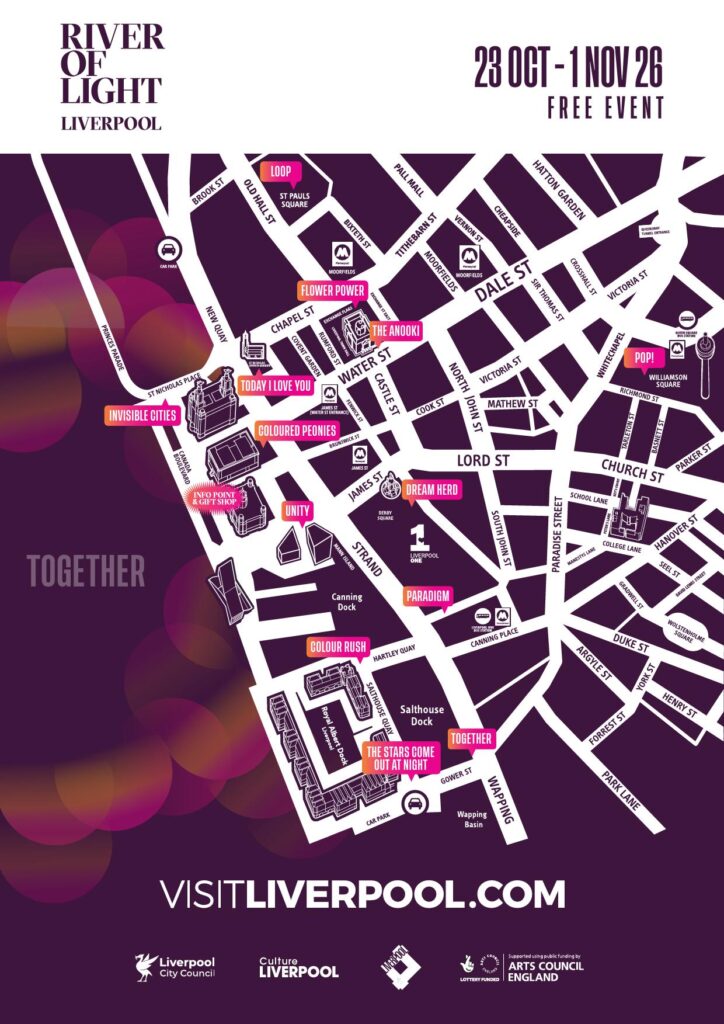
River of Light 2026 Installations
The Anooki by Inook

The Anooki puts this year’s theme of “Together” at the heart of its creation, two playful characters inseparable by their mutual experiences and values of friendship and cooperation.
These Inuit-inspired characters, one boy and one girl, have been travelling the globe since their ice floe disappeared, reminding people about the preciousness of our planet. Since 2012 they have appeared in cities including Lyon (2012), Dubai (2014), Kyiv (2016), Geneva (2020), Doha (2021) and plenty more. Their cheekiness and poetic nature help encourage ongoing discussions around climate change in an accessible and simplistic way.
This year Liverpool is lucky enough to meet these beloved characters, visible to the public while playing hide and seek from behind the structure of Liverpool Town Hall. The Anooki is known for transforming urban spaces into playgrounds and places of freedom, light-heartedness, and discussion, and helping visitors conceptualise their feelings and actions towards the climate crisis.
Location: Liverpool Town Hall, High Street L2 3SW
Colour Rush by Liz West
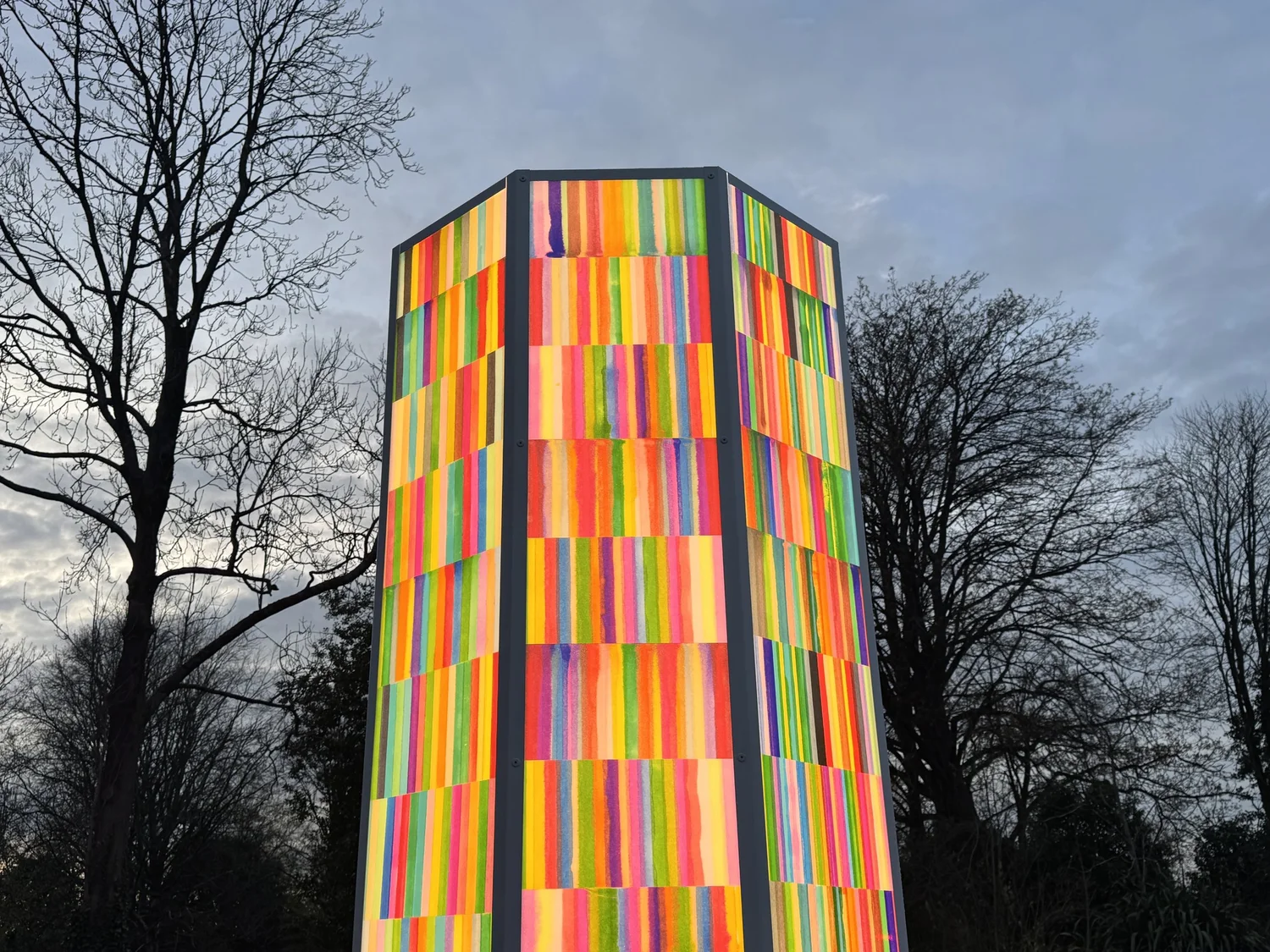
Colour Rush exists as a stimulating light beacon that aims to make visitors closely examine the intricate relationship and pattern between colour, light, vibrancy, and hue.
This piece began life as two large drawings which have since been cut, assorted, rearranged, and eventually the outcome is eight individual stripes, creating a large octagonal structure. The beacon stands as a lightbox placed on a mirrored plinth, reflecting the light and making it seem to visitors that the light is multiplying.
The simplicity, yet intricacy of the piece invites the public to get personal and see their own reflection by closely exploring the beacon. The artwork therefore aims to bring people together through light and see their physical presence merge with other visitors and the colour in front of them.
Location: Martin Luther King Jr Building, Royal Albert Dock L3 4AF
Coloured Peonies by TILT
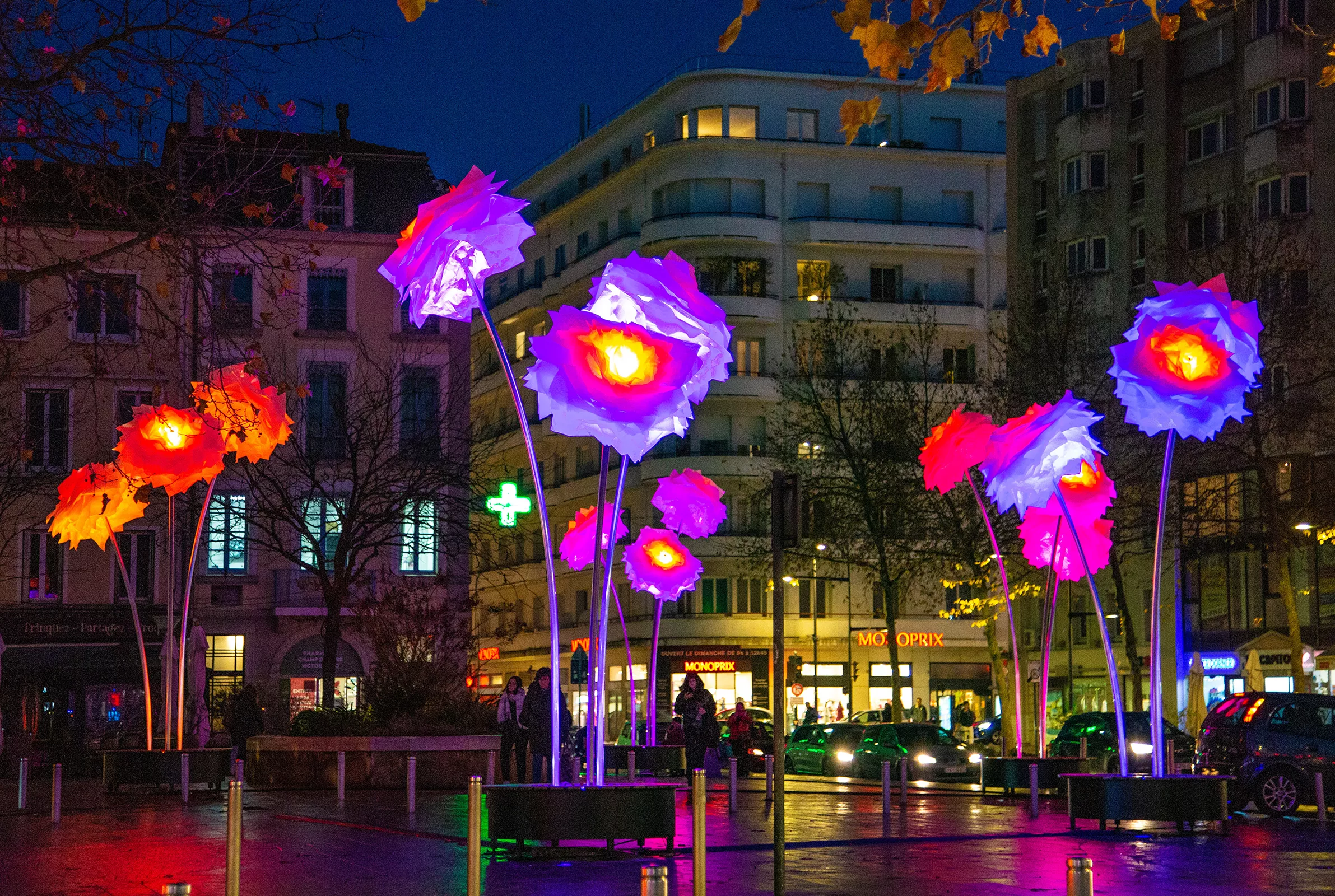
Created by French Artist studio TILT, Coloured Peonies is a six-meter high eye-catching botanical light installation which is elegant by day and a dazzling spectacle by night. Full of grace and natural wonder, this artwork lights up the night with the Cunard Building providing a stunning backdrop.
Ingeniously, this artwork takes a literal approach to the theme of ‘Together’ by creating a gathering opportunity for visitors and the wider community. At the base of the illuminating stems, circular benches have been placed to encourage the public to share the space with others and take the time to reflect on the vibrancy and wonder of the illuminated light
The aim of this piece is to transform the urban space into a dreamlike world where canopies create welcoming spaces for discussion and time to reflect. Both a visual spectacle and deeply thought provoking piece, this installation is one that should not be missed, come day or night.
Location: Cunard Building, The Strand L3 1DD
Dream Herd by Amigo & Amigo

A unique take on counting sheep, this dream-like installation allows visitors to engage with its fanciful nature. From creators Amigo & Amigo, who combine meaningful narratives with joy and recreation, Dream Herd is the perfect interactive installation for all ages.
Combining real world and dream-like states, this interactive artwork gives visitors the ability to escape from reality and immerse themselves in a surrealist space and time. With both light and sound, the public are able to interact with this installation, creating a sense of escaping to another world, all inspired by the simple act of counting sheep.
Each leg of the inflatable sheep included in the piece is unique, they illuminate and emit sound when interacted with, helping to fully immerse visitors in the symbolism of a dream-like world. This is as fun as it gets, what’s not to love about an interactive installation where curiosity is ignited, and a dream-like state is entered under the cover of darkness.
Location: Derby Square, L2 1AB
Flower Power by Spectaculaires – Allumeurs d’images
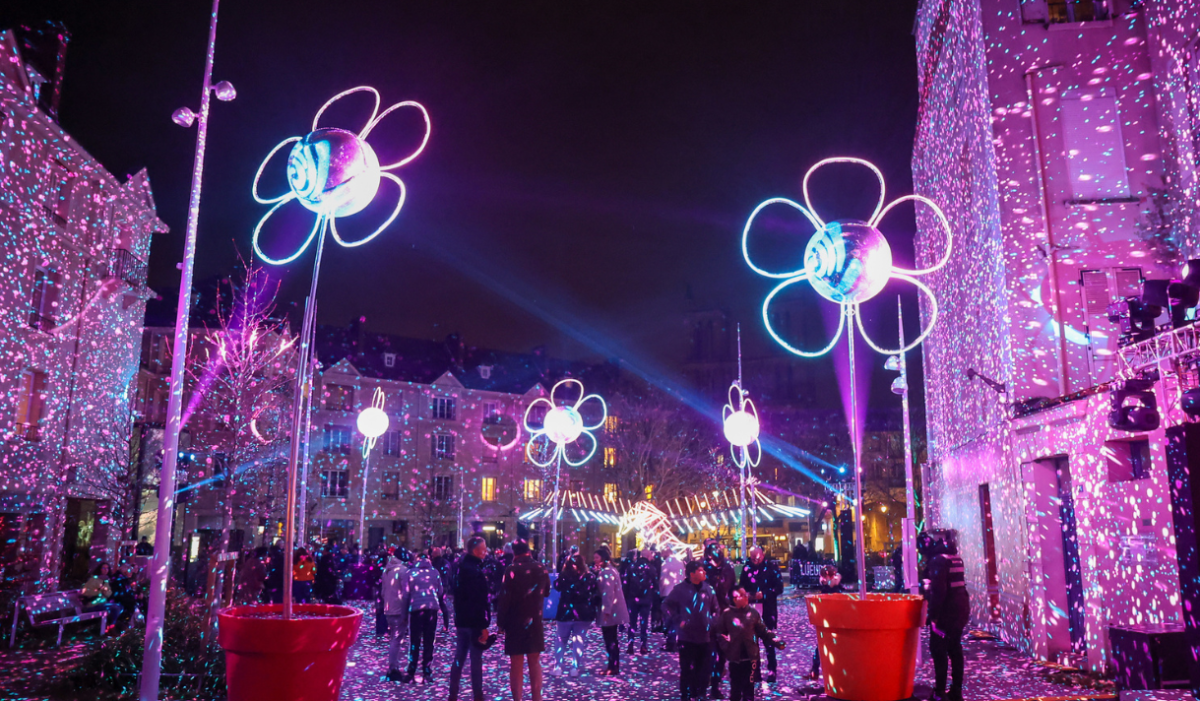
Located in the hustling and bustling Exchange Flags, Flower Power transforms the space into a vibrant and uniquely creative experience for all visitors to enjoy. Created by Spectacularies – Allumeurs d’Images, who have over 35 years experience in transforming space through unique audiovisual creations, this installation is not different.
Each visitor can create their own unique experience by using the interactive jukebox that allows users to select a track from a multi-genre playlist. The floral structures’ illuminations are synchronised to these tracks, allowing for a perfectly timed spectacle all visitors and passers-by can enjoy. Therefore, all people are brought together for a brief moment, to enjoy, to dance, and to play, creating community and small moments of joy.
Skilfully, while each person can create their own experience, the crescendo of this installation is when all the flowers’ unique parts combine to create something beautiful, highlighting how often the best moments are when people work together.
Location: Exchange Flags, L2 3PF
Invisible Cities by Atelier Sisu
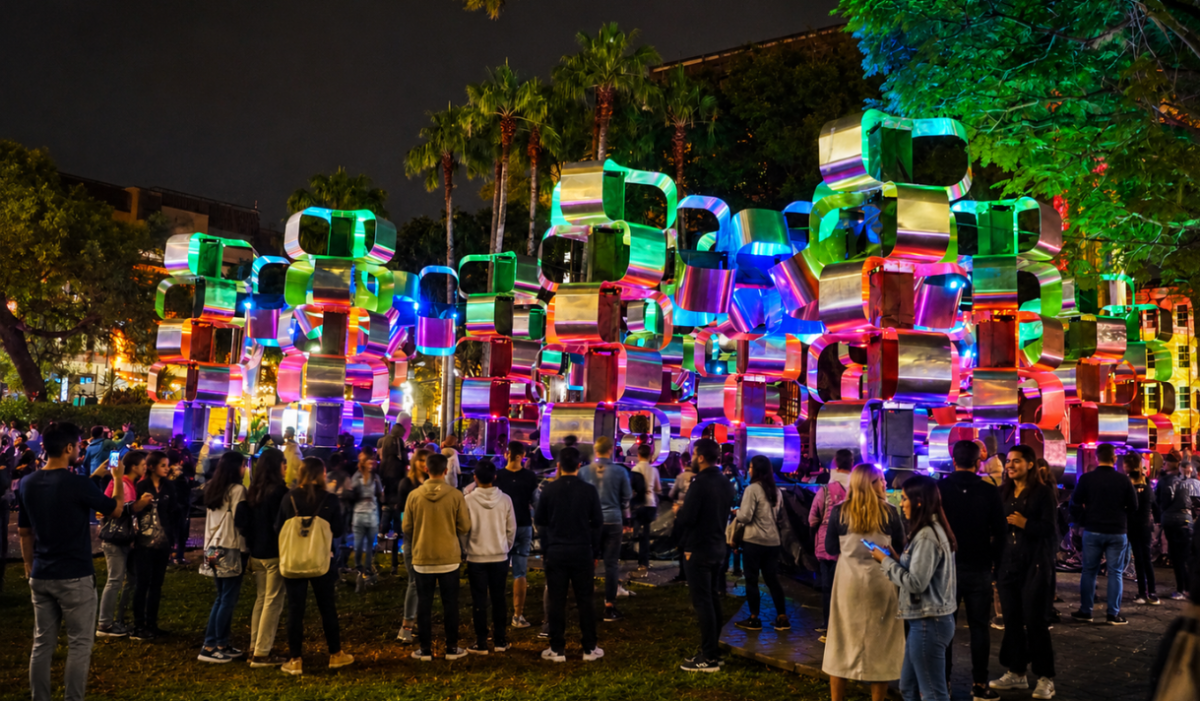
One of the most emotional and thought-provoking installations, Invisible Cities focuses on the spaces in between and the true fabric of the city. Allowing each visitor to take something unique away, this piece encourages people to think about how they interpret their own community, who that involves, and why it means so much.
The individual visitor’s interpretation of this piece changes with their feeling of their own place in society, where they fit, and what it means to them to belong. From students, immigrants, locals, day-trippers, and beyond, all visitors to this installation may take something different away, but in doing so, feel closer to the community and those around them, than before.
The changing colours makes those who interact think about how their neighbours and counterparts also experience the world, championing community through reflection and creativity. Atelier Sisu is the perfect creator for these ideas, as they are known for bringing art into the public consciousness by bridging the gap between extraordinary cultural stories and the everyday spaces within a city.
Location: Pier Head North, L3 1BY
LOOP by Olivier Girouard & Jonathan Villeneuve from EKUMEN
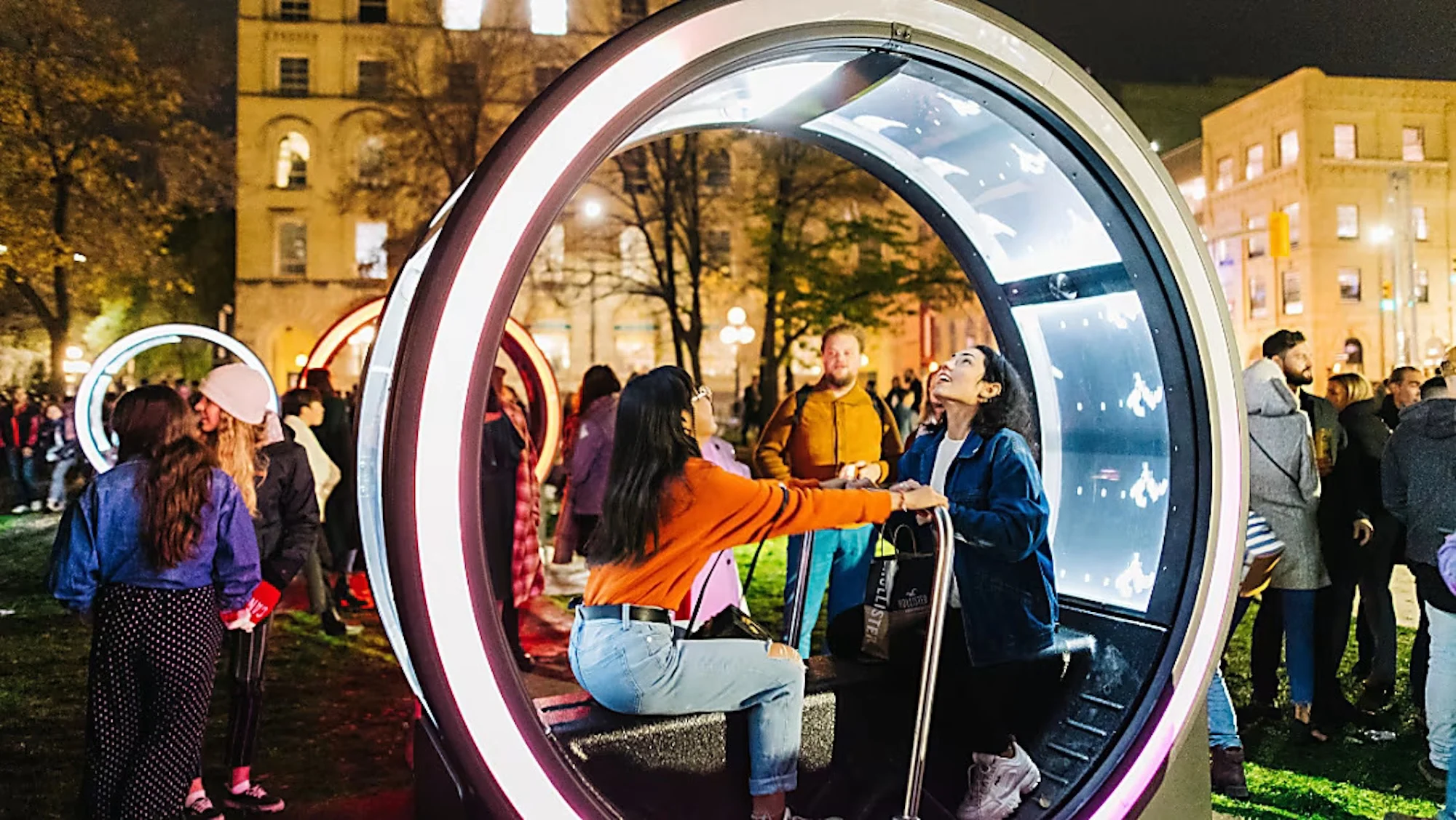
Created in collaboration with British Sri Lankan artist Murugiah, this iteration of LOOP includes 6 giant zoetropes that bring Murugiah’s visual universe to life in a flip-book style manner. Inspired by the 19th century zoetrope device, a pre-film animated device that creates the illusion of motion through movement.
Visitors to this attraction sit inside the giant wheel and oscillate the central lever together to get the motion flowing. As the movement begins, the cylinder begins to spin and the curated graphic designs and strobe effects create the charm of early cinema techniques.
The attractiveness of this installation is bound by its ability to give visitors their own, unique experience. The animation speed, musical rhythm, and effectiveness of the lights are dependent on the visitors movements and force. The River of Light is known for championing a moment to stop and enjoy simple play in public spaces, and this year is no different thanks to installations such as this one.
Location: St Paul’s Square, L3 9SJ
Paradigm by This Is Loop
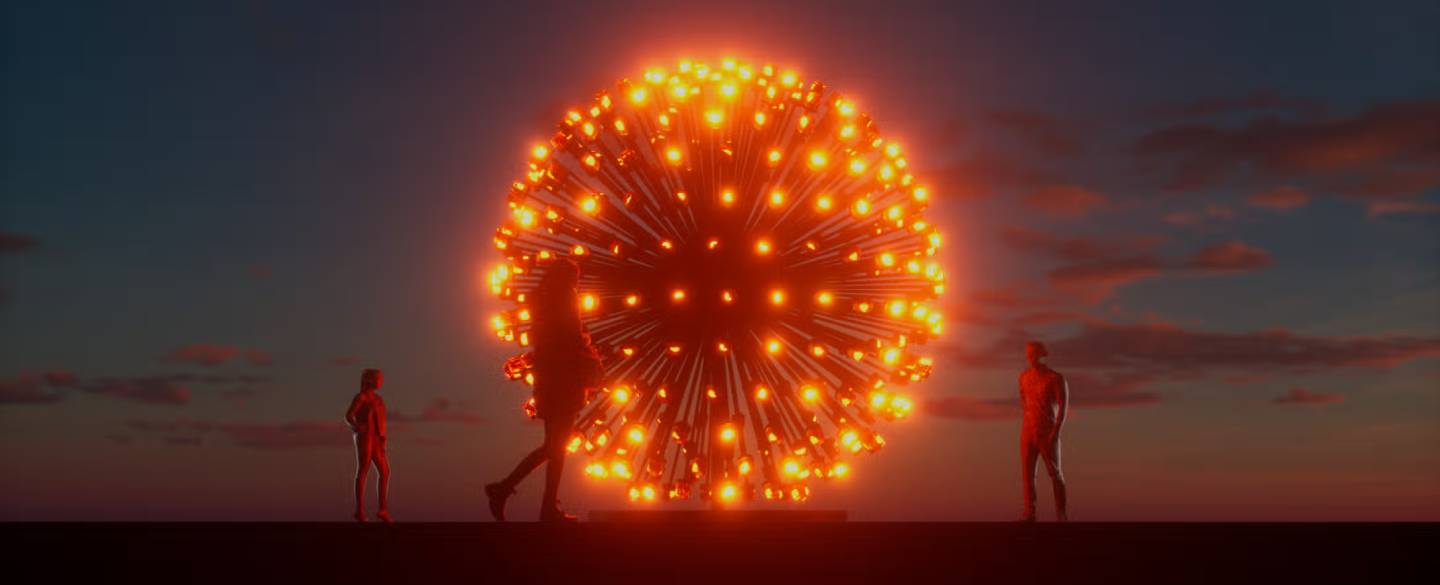
At its core, Paradigm by This Is Loop is an installation that poses questions around how coming together and working harmoniously can make a difference. In partnership with Liverpool ONE, this beacon of light encourages visitors to think about their own actions and how they can work with others actions to create something much bigger and influential.
Somerset based This Is Loop is known for combining art, technology, and architecture to create engaging narratives that transform the everyday spaces. Paradigm is a large beacon of light, made up of individual, much smaller beacons, which signifies the collective impact that lots of individual actions can make when multiplied together.
Location: Thomas Steers Way, Liverpool ONE L1 8LW
POP! by Gentilhomme
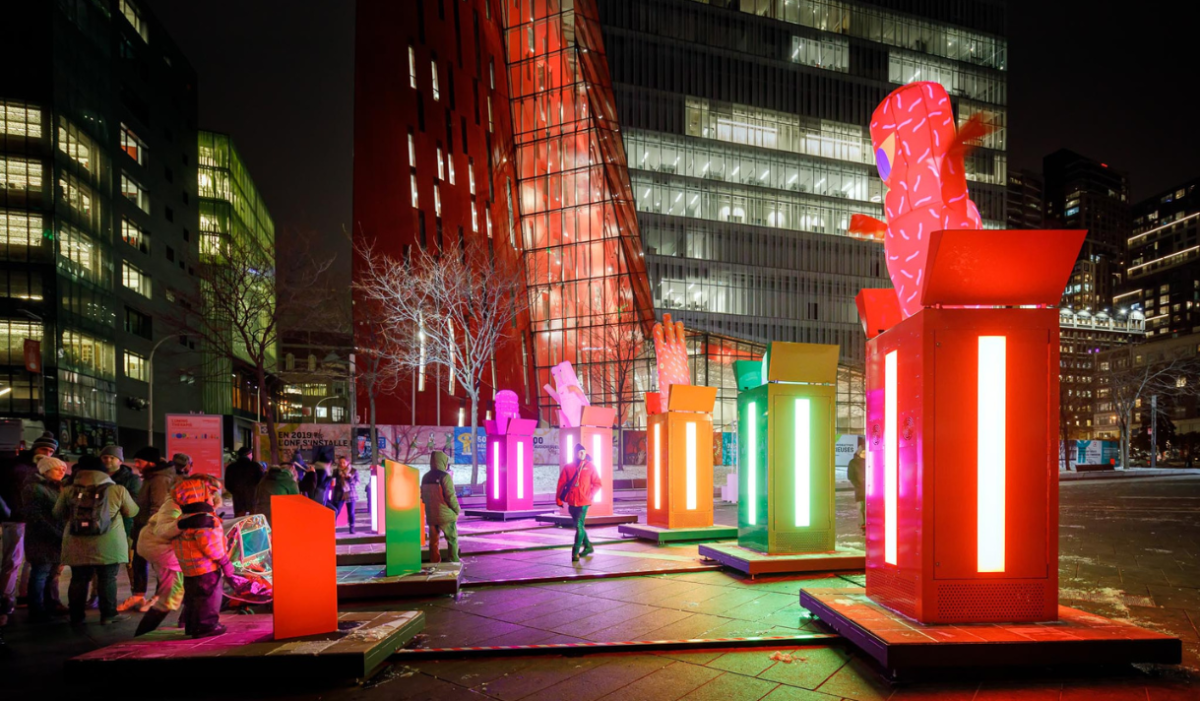
In a true metaphor for togetherness, POP! truly comes alive when visitors collaborate and interact with the installation in unison. Made up of five inflatable puppets, POPO, POPUP, POPLU, POPETTE, and POPOTIN, the public must wake them to release them from their illuminated tower. Waking them by talking, clapping, or singing, visitors can persuade them to come alive and all five puppets can be awoken by audience collaboration to coordinate their energy and noise.
Togetherness is at the heart of this project, and when all visitors work together, music, movement, and light brightens up Williamson Square. The aim of this project is to invite audience interaction and show visitors how collective action can create collective joy.
Multi-award winning studio Gentilhomme are recognised for their work internationally, and this autumn they’re lighting up Liverpool with their vibrant and immersive installation.
Location: Williamson Square, L1 1EJ
The Stars Come Out At Night by Stellar Creates

Stellar Creates have brought the wonder of the night sky right to the heart of the Royal Albert Dock with this striking installation. Simply, it is one large rotating sculpture, but incredibly it manages to capture the awe of the universe and allows the public to immerse themselves within the stars of the night sky.
While each visitor may approach this piece differently, it is a reminder of our relationship with the cosmos and the universe, each and every one of us standing underneath the same stars every night. Despite our unique lives, we are all a part of something much larger, and brought together by our joint fascination with the stars. A poignant reminder to slow down and revel in the everyday wonder with each other.
The warm light of this installation creates a warmth and comfort, while posing one of the most existential questions of the whole exhibition relating to our place in the universe. A quiet reminder that we are all connected in the stardust we carried billions of years ago, and we continue to carry a piece of the universe within us constantly.
Location: Anchor Courtyard, Royal Albert Dock L3 4AS
Today I Love You by Massimo Uberti
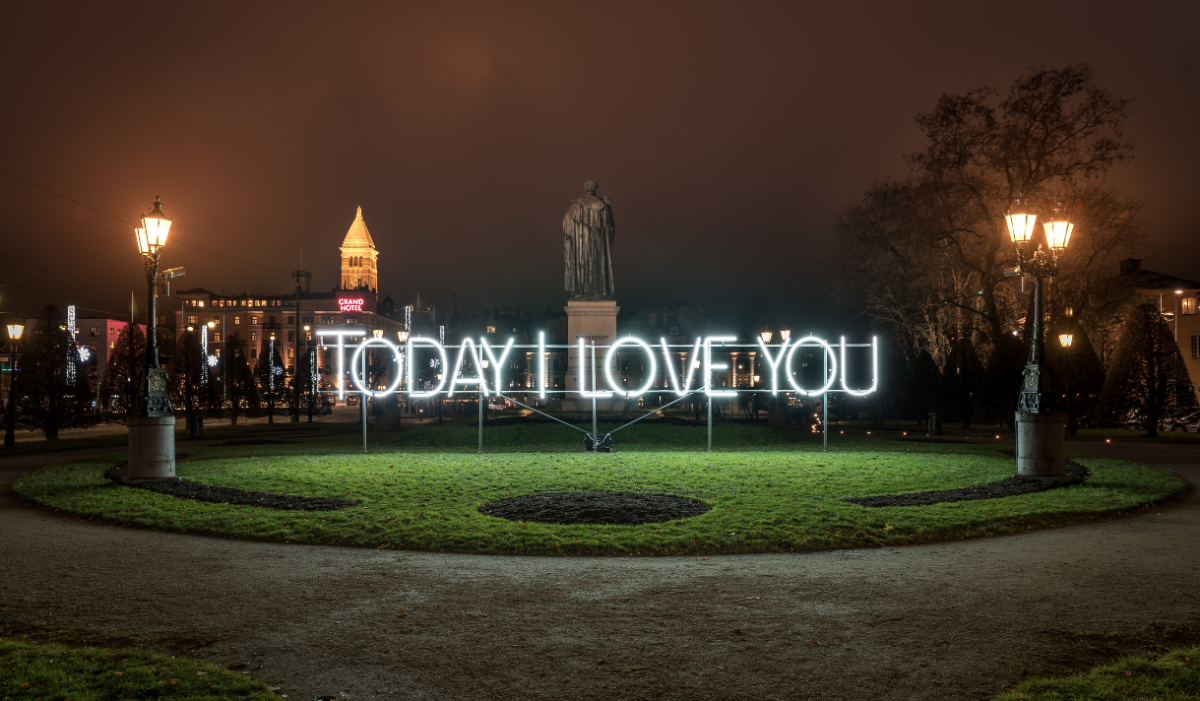
Simple yet moving. “Today I Love You” is a piece by Italian light artist Massimo Uberti that can be interpreted in a variety of ways. As a question, as a statement, as a worry, as a reminder, this is truly at the visitors discretion to interpret. And, that is perhaps the wonder of the piece.
The installations that Uberti creates have an impact in their simplicity, as they leave much for visitors to wonder. This particular installation is simple but illuminated, perhaps to create a sense of joy, and uplift those who visit the piece. Today I love you, while this leaves much to be desired, it helps visitors remind themselves of what they have today and to be grateful for the love they currently receive.
Location: Liverpool Parish Church, L2 8TZ
Together by Murugaih in collaboration with Sam Wiehl and GloMoth
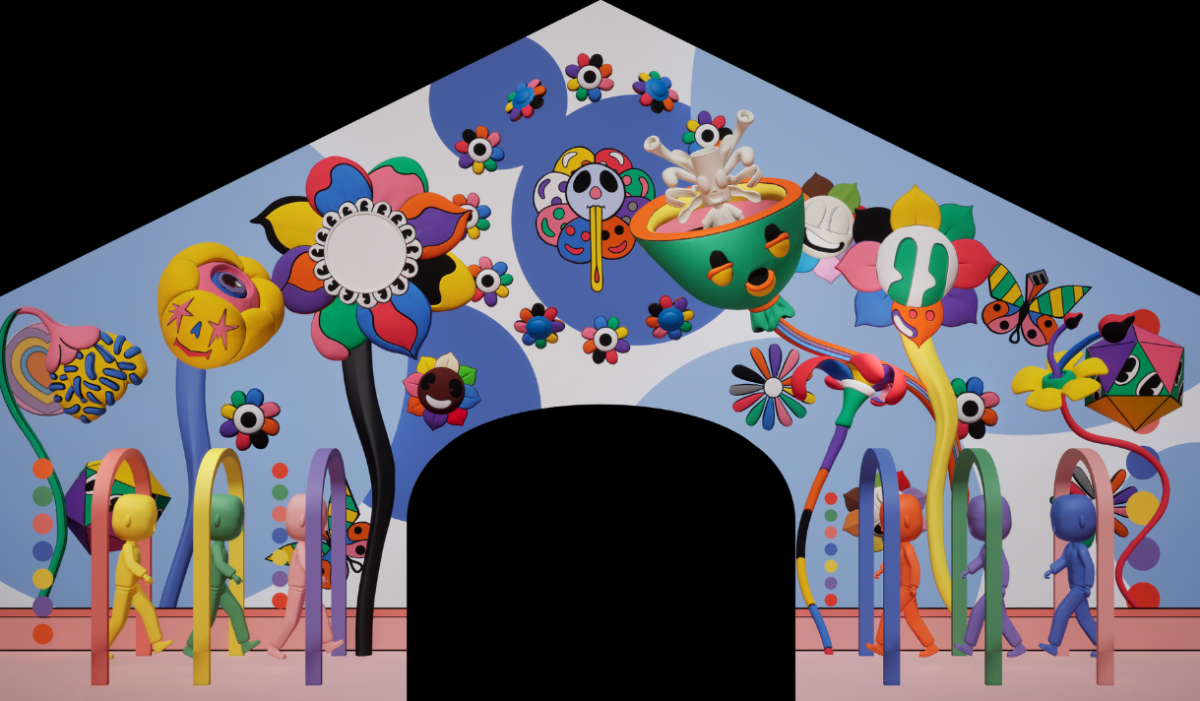
Visitors to this installation enter a wonderful world of colour, expression, and community. The vibrancy and abstract nature of this piece remind those who visit that there is togetherness in an imagined world as the differences we share can truly be a sense of culture and creativity.
The final piece for this year’s River of Light has been enriched through the co-creation with Liverpool City Region community groups including, the Ukrainian Community Centre, Walton Youth and Community Centre, Our House in Walton, Sedgemore Centre and Dovedale & Calderstones Community Group, Greenhouse Project, and Bronte Youth and Community Centre.
At its core, this piece celebrates world-building, community, and togetherness, and is accompanied by a soundscape by GloMoth to further immerse the public in an encompassing atmosphere. Visitors to this installation are encouraged to lose themselves in the joy and vibrance of this world and perhaps imagine their own co-created world and what that would consist of.
Location: Wapping Dock Wall, L3 4BX
Unity by Amigo & Amigo

Togetherness goes hand-in-hand with community, and this installation celebrates and pays tribute to the essential role of community to the world we live in. The five human figures in the piece are joined together, intertwined, and when visitors step inside they are immersed by the unity of humans.
A sense of solidarity is achieved as the spirit of community, collective worth, and resilience is implied to those who visit the installation. For those who step inside the structure, the diversity and joy of humanity is apparent in the array of colour, shapes, and light. Additionally, the floor below is interactive and by hopping about with those around you, more colour and sounds are emitted, enriching the feeling of joy and togetherness further.
Amigo and Amigo are known for their meaningful narratives and this piece brings those who visit it together in its reminder of friendship, harmony, and the power of working together.
Location: George’s Dock Way, L3 1DD
For more information visit visitliverpool.com/river-of-light-2026.
For more inspiration this autumn, explore Uncover Liverpool’s What’s On Listings
Homotopia Festival 2026
The UK’s longest running LGBTQIA+ arts and culture festival returns this Autumn. Liverpool’s Homotopia is back for its 22nd year, with the theme of We Come Together. Running from 17 Oct to 1 Dec 2026, the festival will see theatre, performance, film, music and conversation as it brings Queer creativity in all its forms to venues across Liverpool.
This year, the festival will launch to celebrate the birthday of another iconic Queer community as House of Suarez marks two decades at the heart of the Northern UK vogue scene. With a spectacular runway event, the evening will set the tone for a November programme championing Queer art and artists.
Artists featuring in this year’s Homotopia include; Thick & Tight, Fag Packet, Fatt Butcher, House of Suarez, H.R.H Aphrodite I, Noiregaze, EAT Me Collective, First take.
Highlights of this year’s programme include;
Queer theatre with three shows. Award-winning dance theatre company Thick & Tight with Natural Behaviour, a collection of performed portraits spanning human and non-human life forms. Joining them is Fag Packet with DYKE Systems Ltd, a repeat sell-out at Edinburgh Fringe that serves an anarchic, physical comedy cocktail dissecting pyramid schemes, ruthless heteronormativity, and corporate feminism. Finally, Fatt Butcher performs Congregational an act of coming together. Part concert, part communion, part resurrection – join Fatt Butcher on the dance floor with special guests the Liverpool Rainbow Chorus.
Photographer Helen Constantinou’s The Gathering – Stop The Clause confronts the legacy of Section 28 at Open Eye Gallery capturing the mass protests in 1988 against Section 28, the barbaric UK legislation which banned local authorities from “promoting homosexuality”.
Homotopia is hosting a special screening of Project Triangle at 17: YOUNG QUEER AND STILL HERE. To mark the historic exchange, of Project Triangle, documenting the 2009 journey of Young Homotopia to Auschwitz and Warsaw to explore the persecution of LGBTQIA+ people during the Holocaust and its lasting impact on queer history.
A month of Queer club nights for dancing feet including EAT Me Collective with HORRIBLE HERSTORIES, Noiregayze, Protect Scouse Dolls, Homotopia edition of Sonic Yootha and Queer Cxntry Burnin’ Daylight, a country music themed LGBTQIA+ club night by PINK SUITS.
A Reel Queer film screening marking the 40th anniversary of Liverpool production company, First Take.
Dine in the converted stables of Cobble and Hay in historic Port Sunlight for Cookery Book Club at the Movies, featuring a menu inspired by Fried Green Tomatoes at the Whistle Stop Cafe.
Commemorations for World AIDS Day with Sahir House and a screening of April Ashley in Enigma for Transgender Day of Remembrance.
An evening with the next generation of Queer talent with Young Homotopia and QueerCore Showcase.
View Homotopia Festival 2026 Brochure
Liverpool Literary Festival
The Liverpool Literary Festival is a fascinating weekend of discussions, readings and debates in one of the most dynamic, culturally vibrant cities in the world.
This year their festival is on Friday 16 – Sunday 18 October and they will be welcoming local authors, poets, best-selling novelists and many more to their iconic Victoria Gallery & Museum.
Writers appearing include Roger McGough, Samira Ahmed, Alexandra Potter and Frank Cottrell-Boyce.
For full details and listings, visit here
Kabannas accommodation deal
Thinking of attending a LivIrishFest event? Or, perhaps, the heritage sites of the Liverpool Irish Famine Trail are calling you?
Well, we’re delighted to announce that the kind people at Liverpool Kabannas have conjured up a discount code that snips an impressive 20% off the price of staying at their Mathew Street property. Yes, that’s Mathew Street in the bustling heart of Liverpool!
Use the following code, when booking on their website, to avail of the offer: irishfest
Click here to book.
Go on, get your groovy socks (and/or sandals) on and make your way to the glorious port of Liverpool ASAP! You know we love to have visitors and Kabannas is great for groups, so why not bring some friends? ❤️?❤️
What do Kabannas say about themselves?
Traveling with friends as a couple or with colleagues? Kabannas Liverpool is ideal for group travellers, friends, couples and business professionals alike. You’ll love our cosy rooms, on-site restaurant and bar, friendly service, and unbeatable central location.
Looking for a cheap hotel in Liverpool? Kabannas has you covered! Whether you’re planning a fun city break in Liverpool, a mid-week stay, or you’re here on business, we offer affordable accommodation in Liverpool’s city centre that doesn’t skimp on comfort.
Located in the buzzing Cavern Quarter, Kabannas Hotel Liverpool is just a short walk from Liverpool Lime Street Station and the famous Royal Albert Dock – right in the heart of the action. Step outside and dive into Liverpool’s vibrant nightlife, explore the city’s iconic landmarks, or kick back and relax in Kabin our on-site bar and cafe.
Image of Mathew Street (detail only) (c) Superchilum, CC BY-SA 4.0, via Wiki Commons.
Possession (1981): Halloween Weekend Screening
Friday 30 October · 81 Renshaw, LiverpoolDoors 6:30pm · film approx. 7pm · 18+
Obscure Film and Fringe Flicks join forces for a Halloween-weekend screening of Andrzej Żuławski’s cult classic Possession (1981), closing Scalarama Liverpool 2026.
Set against Cold War Berlin and starring Isabelle Adjani and Sam Neill, Possession begins with the collapse of a marriage before spiralling into paranoia, obsession, body horror and something much harder to explain.
Feverish, unsettling and extraordinary, it’s a film made to be experienced on the big screen.
We’re making a suitably strange night of it too. After the film, anyone feeling brave can enter our Possession scene-recreation challenge, inspired by one of the film’s most infamous sequences, with fabulous prizes to be won.
Taking part is completely optional. Sitting back and watching other people make questionable performance decisions is also entirely acceptable.
There’ll also be a specially commissioned alternative Possession poster, screen printed at Liverpool Community Print Station and available on the night.
The screening is presented by Obscure Film + Fringe Flicks / People Versus TV as the closing event of Scalarama Liverpool 2026, a month-long celebration of independent and DIY cinema across the city.
Liverpool Irish Festival 2026
Liverpool Irish Festival, the UK’s largest Irish arts and culture led festival has announced 40 events and exhibits across the 2026 festival.
Run across ten days (Thurs 15–Sun 25 Oct 2026), with satellite events extending from 1 Oct–2 Nov, the Festival anticipates visits of 7,500–10,000. Rooted in the story of the 1.8 million Irish Famine poor who entered Liverpool through Clarence Dock between 1845-1853 and those that have followed, this year’s theme — I Am Here — asks what it means to arrive, to stay, and to be seen.
Headline acts
Headline acts include the return of Dublin seven-piece Kíla for the first time in eight years (Fri 16 Oct) and Téada (Fri 23 Oct), celebrating 25 years on the road, both at Liverpool Philharmonic Music Room; the launch of Professor Frank Shovlin’s authorised biography of John McGahern, published by Faber (Sun 18 Oct); and Don Wycherley in the award-winning The Life and Times of Paddy Armstrong (Fri 30–Sat 31 Oct, Unity Theatre). The Festival is opened by someone who really knows what it costs to say I Am Here, transplant survivor, storyteller and musician Enda McCabe (Wed 14 Oct, Liverpool Irish Centre).
This year’s theme, I Am Here, is a declaration of presence. Stating it is an act of arrival, a claim on space and the right to be seen, named and recognised on your own terms. As well as providing rich entertainment and creativity, this year’s programme explores histories that remain painful or contested, including An Gorta Mór (the Great Hunger), the Troubles and institutional abuse in Ireland. The Festival approaches these with care, guided by its published Philosophy for Practice, providing care notices, post-show conversations and signposted support services throughout. New for 2026, access social stories are available for Festival venues, supporting neurodivergent visitors and those with access needs. Bursary places remain available for anyone for whom ticket prices would prevent attendance.
Programme Highlights
Heritage at the heart
The An Gorta Mór vigil (Sun 25 Oct, 10am) retraces The Walk of the Bronze Shoes route from Clarence Dock — entry point for over 1.8 million Irish Famine poor — to St Luke’s Bombed Out Church, leading into the annual An Gorta Mór memorial (1pm), where the commissioned song The Ullaloo will be led by the Liverpool Irish Centre choir. Trail work has been supported by The National Lottery Heritage Fund.
New Liverpool Irish Famine Trail tours (Sat 24 Oct) use our trail app and headsets, while a Scotland Road community tour (Sun 18 Oct) visits Vauxhall Neighbourhood Council, St Anthony’s Church and The Rotunda, alongside a South Liverpool walking tour the same afternoon.
Shared Lands (Mon 26 Oct, LJMU) shares new research on the Choctaw Nation’s extraordinary 1847 gift to the starving in Ireland sharing an act of solidarity from a people sixteen years into their own forced removal. Our annual Tony Birtill memorial lecture will allow our community to reflect on his legacy (Tue 20 Oct, Liverpool Irish Centre).
Theatre and performance
The Life and Times of Paddy Armstrong (Fri 30–Sat 31 Oct, Unity Theatre) stars Don Wycherley as a man wrongfully convicted fifty years ago, with post-show conversations. Victoria Fradgley’s High Tea (Sat 17 Oct, Liverpool Irish Centre) is a sharp reckoning between two estranged sisters; Geraldine Moloney Judge performs her sell-out Obscured View (Wed 21 Oct, Hope Street Theatre), celebrating Liverpool and Ireland’s shared love of football. New for 2026, Movema and live band The Saltcutters lead a gender-free everyone-dances-with-everyone céilí (Sat 17 Oct, St Bride’s Church).
Music and tradition
Kíla bring three decades of genre-defying sound — from uilleann pipes to djembe — to Liverpool Philharmonic Music Room (Fri 16 Oct). Téada follow (Fri 23 Oct), presented with Return to London Town and supported by Culture Ireland. I Am Here (Thurs 22 Oct, Sefton Park Palm House) gathers over 50 musicians and dancers from the George Ferguson Irish Dance School and Melody Makers. The Phogues (Sat 24 Oct, Liverpool Irish Centre) mark 40 years since The Pogues‘ debut album Red Roses for Me, and two seisiúns (Fri 16 and 23 Oct) offer traditional music at Peter Kavanagh’s, whilst an Irish set dancing course begins Tue 27 Oct at Liverpool Cricket Club.
Literary voices
A full Central Library author day (Sat 17 Oct) offers four free events: Vitor Vicente on a writer’s decade in Ireland; Sue Divin presenting her border-set novel Runaway Road; Doug Devaney on inherited diaspora identity through Black Vinyl; and PJ McKeown’s punk memoir By Acting the Fool. Faber publish Professor Frank Shovlin’s authorised biography of John McGahern (Sun 18 Oct, Victoria Gallery and Museum), followed by the seventh John McGahern Annual Book Prize. Historian Sonja Tiernan celebrates Eva Gore-Booth: Irish radical poet, rebel and reformer (Mon 19 Oct, The Black-E).
Family focus
Family Day (Sat 24 Oct, Museum of Liverpool) features The Armagh Rhymers‘ exclusive Liver Bird story, Merseyside dance schools, Melody Makers and Brave Maeve children’s activities. The Samhain Céilí (Sun 25 Oct, Liverpool Irish Centre) closes the Festival with costume competitions, music and gift bags.
Visual arts and film
In the Window: Adam Frew and Maureen Lynch (1–31 Oct, Bluecoat Display Centre) pairs County Derry porcelain with Dún Laoghaire silver. The St Brigid’s Arms (from 2 Oct, Victoria Gallery and Museum) opens a fictional Irish pub created by and for women of Irish heritage, with tours and Q&As (20 and 22 Oct). Testimony (Sat 7 Nov, The Bluecoat), Aoife Kelleher’s documentary on survivors of the Magdalene Laundries and Mother and Baby Homes, screens with Fréa‘s Renewing Roots programme, followed by conversation.
The Festival previews at 6pm on Wed 14 Oct with a preview launch supported and hosted by the Consulate of Ireland at the Liverpool Irish Centre. The evening features musician Enda McCabe — back performing after a kidney transplant — a living embodiment of I Am Here. The Festival’s Cultural Connectedness Exchange Network (#CCEN) gathers for its annual practice day the following morning (Thurs 15 Oct, Victoria Gallery and Museum).