

By Kevin Eccleston
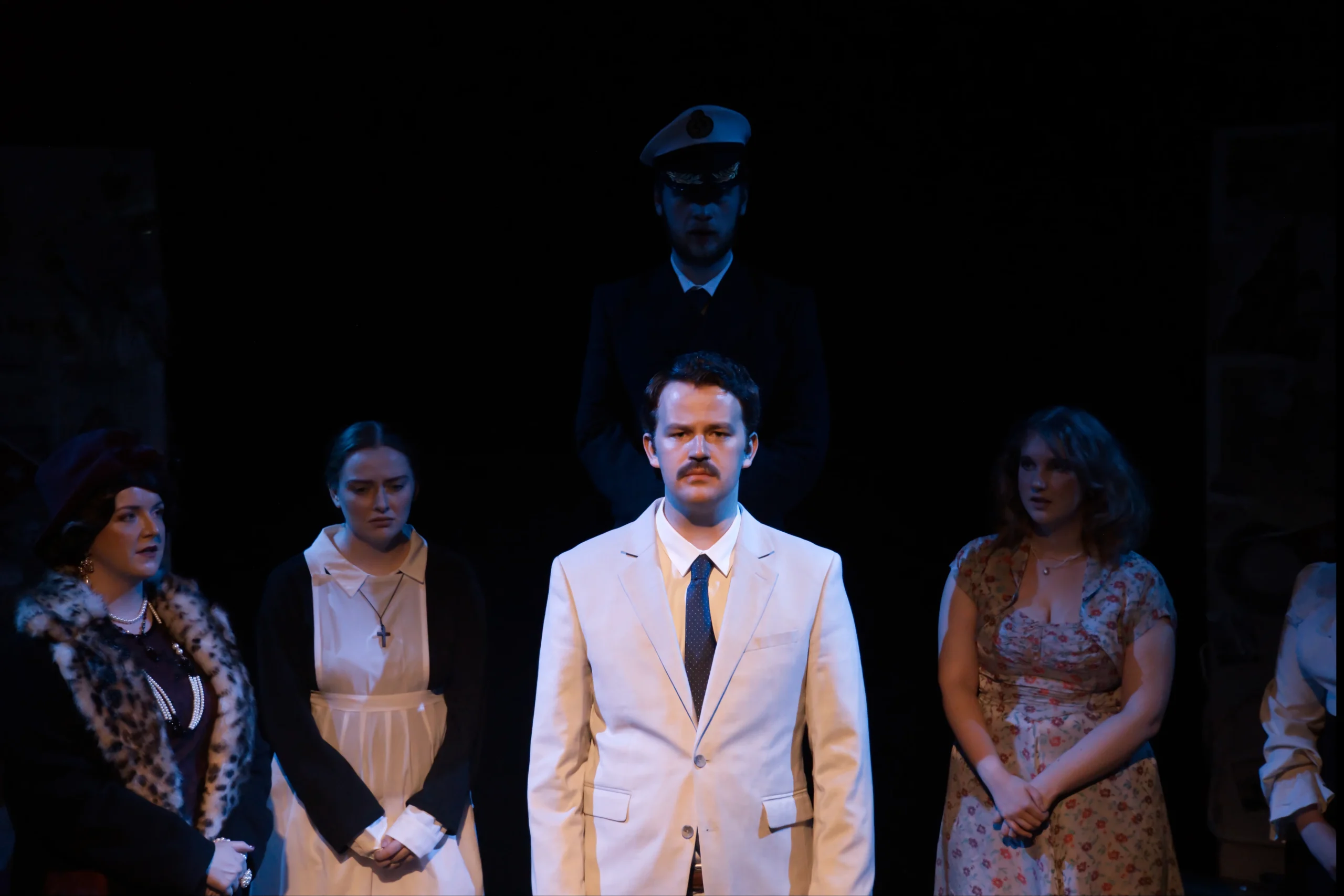
More than a century after the Titanic sank, the disaster continues to fascinate audiences. Countless books, films and stage productions have revisited the tragedy, its victims and the extraordinary circumstances surrounding that fateful night.
But Unsinkable, currently being staged at Liverpool’s Hope Street Theatre, chooses not to tell the story we already know.
Written and directed by Matthew Reynolds, the play instead turns its attention to J. Bruce Ismay, chairman of the White Star Line and one of the most controversial figures associated with the Titanic. Ismay survived the disaster. That fact would become his defining legacy.
His decision to enter a lifeboat while many passengers and crew were still aboard led to widespread condemnation, transforming him into a convenient villain in the public story of the Titanic. More than 100 years later, that reputation remains remarkably persistent.
Unsinkable asks us to look beyond it.
Joseph Winder takes on the role of Ismay, having previously played the character during the production’s earlier development. His performance gives the play its central focus as Ismay confronts the events of the disaster and the consequences that followed. Winder is supported by a talented cast including Christopher Forrest as The Inquirer who holds many of the scenes together whilst plaing a challenge to Isam., Emily Guilfoyle as Marian Thayer. Charlie Forrest as Officer Lightoller. Rosabelle Bennett as Florence Ismay who sruggles with the pressure put upon her marriage by the public’s feelings towards her husband. Alice McKillop plays the feisty activist Margaret ‘Molly’ Brown and Lorna Jane Ryan playing the part of Violet Jessop.
Rather than attempting to recreate the scale of the Titanic itself, Reynolds keeps the production intimate. The drama is driven by dialogue, memories and the gradual unpicking of a question that is far more complicated than simply asking whether Ismay was a hero or a villain.
What does it mean to survive when others do not? How does someone live with the knowledge that history has already decided who they are? Those questions give Unsinkable its dramatic strength. Ismay is not presented simply as a historical figure to be judged, but as a man forced to confront the consequences of an event that would define the remainder of his life.
There is also something particularly appropriate about seeing this story performed in Liverpool. The city’s maritime heritage is inseparable from the Titanic story, and Hope Street Theatre provides an interesting setting for a production that examines one of the key figures connected with the disaster.
The play itself has an interesting Liverpool theatre journey. It began life as a shorter piece entered into Tip Tray Theatre’s What Happens Next? competition before being developed into a full-length production. A sold-out staged reading subsequently provided an opportunity to test the material with an audience before its move to the Hope Street stage.
That development is reflected in a production that knows exactly where its interest lies. This is not a show about recreating the spectacle of Titanic’s final hours. It is a character-driven examination of what happened afterwards — and of the way public opinion can shape the historical reputation of an individual.
The Titanic story may be familiar, but Unsinkable demonstrates that there are still different perspectives to explore.
By placing Bruce Ismay rather than the sinking itself at the heart of the drama, Matthew Reynolds offers an alternative way of considering one of the most famous tragedies in maritime history. Whether audiences leave feeling sympathy for Ismay, continued suspicion, or simply a greater sense of uncertainty about the man behind the legend is ultimately left to them. Interestingly Reynolds touches in the issue of equal rights when touching on the allocation of lifeboat places.
And perhaps the play’s most interesting achievement: it doesn’t try to provide an easy answer to all these questions.
Unsinkable is a story steeped in devotion and ruin, where every regret feels like a love letter written too late.