

By John Maguire
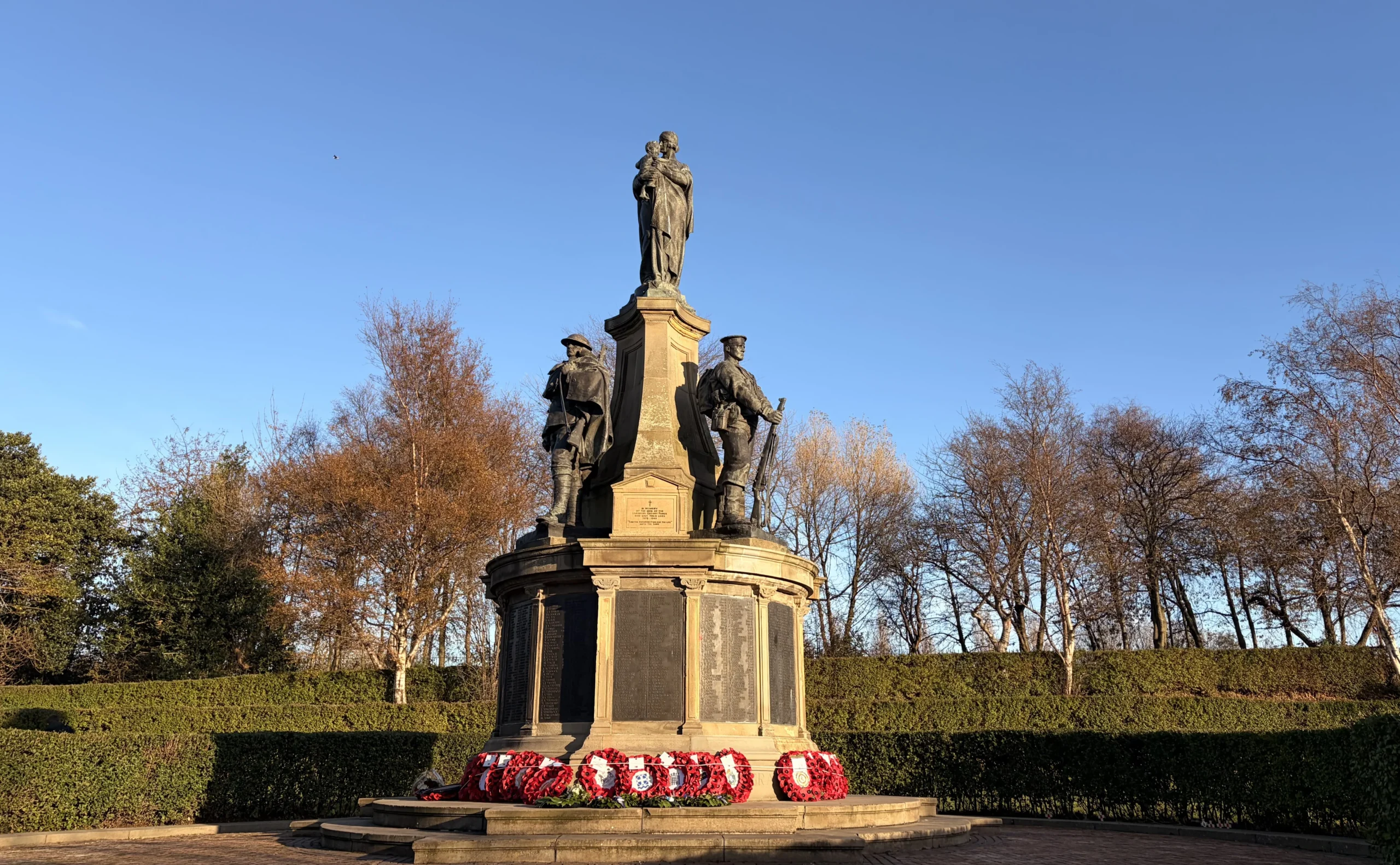
In this edition of Buried Treasure, John Maguire of ArtsGroupie CIC explores the overlooked stories behind Bootle’s Irish war memorial, reflecting on the sacrifices of Irish servicemen and women and the ‘Canary Girls’ who undertook dangerous work in local munitions factories.
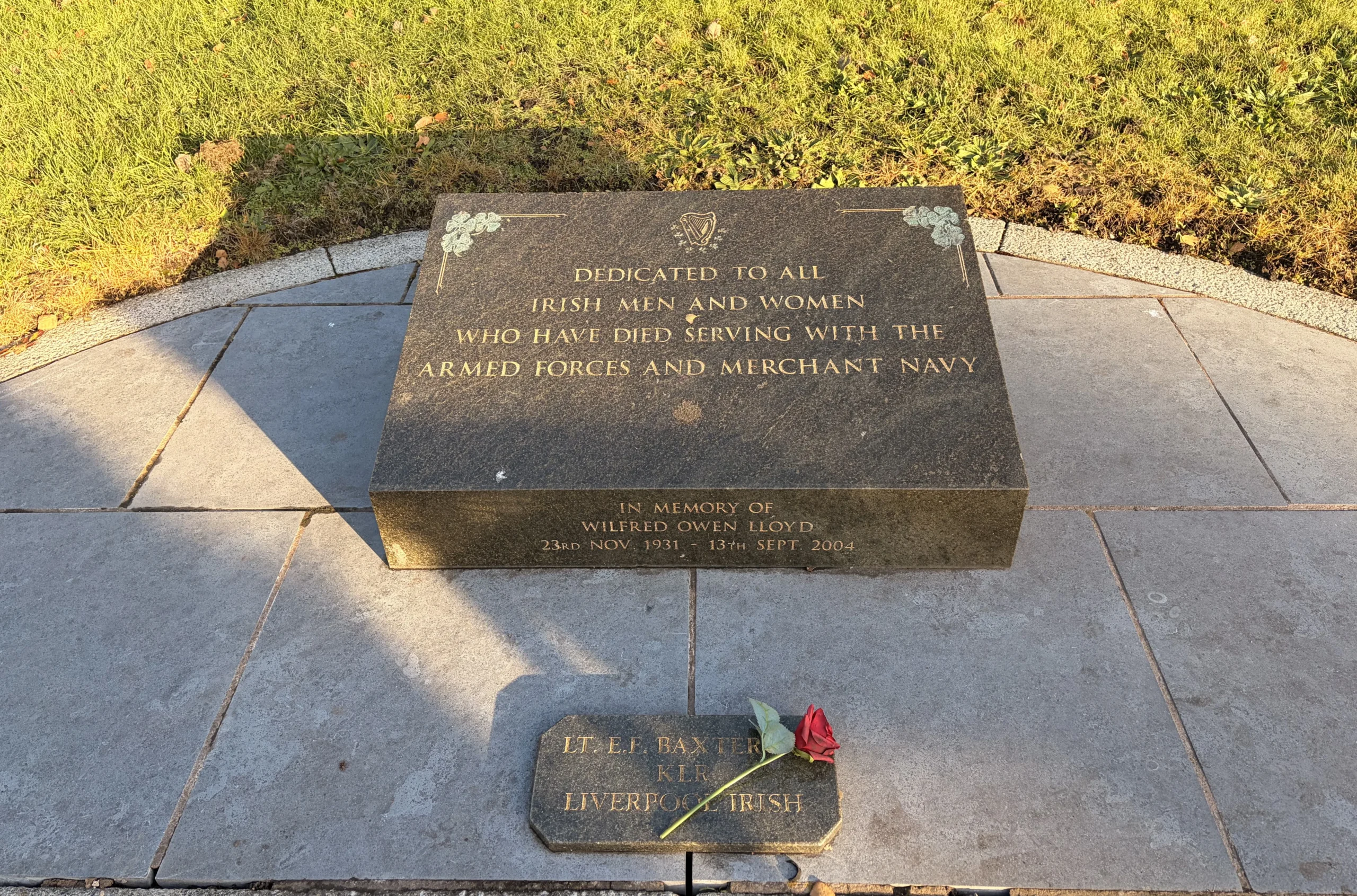
The Irish war memorial in Bootle is a specific tablet located within the wider Bootle war monument in King’s Gardens, Stanley Road. A simple stone block dedicated to Irish men and women who died serving in the armed forces and the merchant navy. While the Grade II* listed Bootle war statue featuring the mother and child is well known, the specific Irish commemorative plaque is often overlooked by passersby.
It represents a community central to Bootle’s identity, but whose specific sacrifices were sometimes hidden due to the complex political relationship between Britain and Ireland in the early 20th century. How many people walk past this without understanding that Bootle was shaped by the Irish, being a primary landing point for Irish families arriving at the North Docks, where many Irish migrants settled and worked. Bootle’s expansion from a rural village into a major industrial town was heavily fuelled by Irish migration following the Great Famine (An Gorta Mór). Living conditions saw Irish labourers often forced into extreme poverty and overcrowded housing.
Irish navvies were primarily responsible for digging canals and building the railways and docks that established Bootle as a major industrial port, helping to develop the infrastructure from 1860 to 1940: like the Langton Pumphouse (1879) and the Bootle Town Hall by John Johnson (1882), built on the wealth generated by dock trade in Renaissance style.
For a Bootle soldier, specifically an Irish one, it was a complex issue, a catch-22. Vital to the war effort and the docks, yet the stories are often hidden because they were neither fully British in the eyes of some nor Irish enough back home. Irish soldiers were sometimes viewed with suspicion or as outsiders because they were Irish. Fighting for the Brits was often seen as treason, resulting in men and women who didn’t talk about service, hidden stories that didn’t quite fit the standard ‘Brit hero’ or ‘Irish Patriot.’
Bootle was a vital hub for the Battle of the Atlantic. The memorial specifically honours the Merchant Navy, a group of hidden heroes who were often civilians facing naval warfare. One in five Irish mariners perished on missions on unarmed ships. Local legends in the roll call include Corporal James Ahern, of 35 Hertford Road, Bootle, who died on 22 August 1917, at the age of 22, recommended for the Distinguished Conduct Medal, ‘For conspicuous gallantry and devotion to duty. When an enemy shell set fire to a large dump of ammunition, Corporal Ahern, with utter disregard for his own safety, rushed to the spot and succeeded in extinguishing the fire with his own coat and blankets while shells were exploding all around him. His prompt and courageous action undoubtedly saved a very serious situation.’
Cpl James Ahern
D/306 Brigade of the RFA
(Service No. 696515)
35 Hertford Road, Bootle
Distinguished Conduct Medal (DCM)
Sefton War Memorials Database; cross-referenced with Royal Field Artillery Unit War Diaries (1917).
Sacrifice was not confined to the battlefield. On the home front, local women stepped into their own hidden, hazardous roles as ‘Canary Girls’ in munitions factories nearby at ROF Aintree during WWI and ROF Kirkby in WWII, a sprawling complex employing over 20,000 women across Merseyside and Lancashire. Working long hours in cold and damp concrete fill-rooms where heating and flames were strictly banned due to explosion risks, they packed high-explosive TNT and Amatol into shells and landmines by hand. The fine toxic dust settled into their skin, hair, and eyes, causing toxic jaundice that turned them physically yellow, earning them their nickname, while risking their long-term health with little recognition.
You can discover more about local servicemen and women through the Sefton War Memorials Project—a Heritage Lottery-funded initiative documenting roughly 4,000 Sefton residents across World War I and World War II: seftonwarmemorials.org.